28 Kasım 2010 Pazar

festive lighting...

Diwali is long gone and it's time for Christmas with reds & greens, cakes & cookies and loads of happiness....
...but festivity can never go out of style, can it?

I received a mail, few weeks back from one of Rang Decor's readers Rama Ananth and she wanted to share some of her Diwali moments with all of us. I loved the way she has used fairy lights and other traditional lamps to bring in festivity.

Here are few captures from her lovely home.
These are truly beautiful Rama, thanks for sharing it with readers of Rang Decor!

(images by Rama Ananth)

26 Kasım 2010 Cuma

A Hundred Hands...

A Hundred Hands is a nonprofit trust based in Bangalore, India.

Their vision is to create a world that celebrates the pleasure of handmade crafts in our homes and daily lives.

'The Handmade Collective' A showcase and sale of all things handmade is on and I had an opportunity to drop by yesterday and enjoy the beauty of various handcrafted work.

The gracious Mala Dhawan of A Hundred Hands showed me around and here are few lovely products that I captured from a variety of handmade goodies...
Amazing Aepan painting on tealight holder lamps...
Gift boxes...
'Aepan is a unique craft of the Kumaoni folk , where they use finger nails, originally done on walls. Intricate patterns are made using natural dyes as this craft gets a new lease of life decorating homes and office stationery.'
Christmas gift items by Flower Belles Decorators...
I just loved this idea of having fairy lights decorated with recycled egg crates by eCoexhist...
Eco-friendly Ganesha by eCoexist...Beautiful Sanjhi Art...
'Sanjhi is an art of cutting paper on non metallic surfaces with the help of plied scissors and sharp blades. While this craft flourished since its origin in the lands associate with Krishna, in Mathura and Vrindavan, Uttar Pradesh, today only one family claims to be carrying it forward through it's fifth generation of artists.'
Lush green plants for sale...
Beeswax products...
Hase Chitra, a tribal art form from Shimoga and Karwar district of Karnataka. Usually done on special occasions like weddings etc, now trying to bring it into our modern everyday life by painting on canvas and metal...

It was a great to learn about some very interesting art forms of India, that are being revived by 'A Hundred Hands...'

Do drop by at
A Handmade Collective
24th Nov to 28th Nov. 2010
4, Ashley Road, Behind Hotel Ajanta
off Brunton Cross Road
Bangalore

Do check out their Facebook page for other updates.


(images by Arch

Art by Aarohi...

Nazar Batto Box...
Today, I dropped by at Aarohi Singh's exhibition at Pageturners Bookstore and was completely engulfed into a world of vibrant colours and Indian Kitsch.

Here are few captures of her wonderful work.
Side View of the box...
Horn Ok Please Kettle...
Thayyam Box...
Nimboo Mirchi Series Paintings...
Gorgeous Thalis (psst...that lovely Goddess Saraswati thali will soon be mine;-)
The lovely lady with her stunning work:-)

Aarohi's exhibition is on till 28th November, 2010 at
Pageturners Bookstore,
89 Kannan Building, MG Road, Bangalore

So if you are in Bangalore, do drop by:-)

22 Kasım 2010 Pazartesi

About being friends

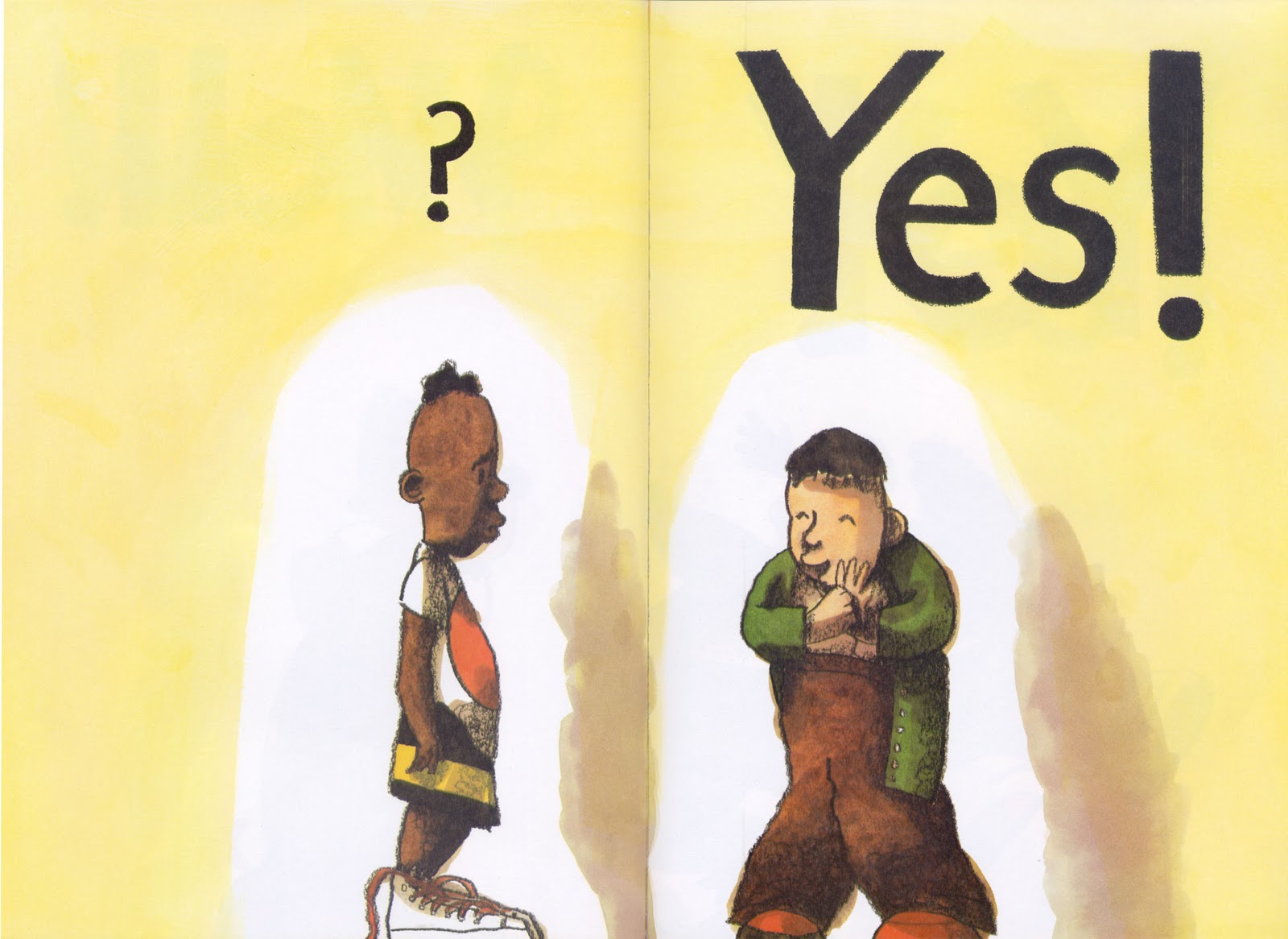
Yo! Yes? is one of my most  favourite of picturebooks.  Its simplicity is deceiving, with one or two words on a page seen together with apparently hasty watercolour / charcoal illustrations - the combination of image / word is brilliant. It's a simple story - two boys meet, they talk and become friends.  But that very short summary ignores the visual impact of each page and double spread. Chris Raschka uses a large (I think) hand written font for each punctuated utterance, and it becomes as much part of the image as his vibrant depictions of the two boys, one black the other white.  


Don't miss the dedication and copyright page, which shows us how the two boys meet, walking past each other in the street. One solitary black boy waiting, arms crossed, but facing us.  Large trainers, laces undone. He's  happy, and ready to talk to anyone. The white boy is intent on walking away, anywhere as long as it's away, he's sad too, we can see his turned down mouth and his shoulders are haunched inwards. 


Chris Raschka has painted the background in light washes, starting with a greeny blue and moving through pinky red, orangey yellow and finally a glowing bright yellow, they represent the emotions on each page.  And each figure is outlined by this wash, as though in a spotlight, a spotlight for each boy - visually it both unites and separates them on the page - they are both boys, yet different. 


Moving into the book, our young black 'dude', (for he is definitely cool), stops this possible friend in mid-step, when we turn the page we see a large arresting 'Yo!' and Chris Raschka's figures ooze unspoken communication. The white boy's posture, with simple charcoaled eyes and mouth, together with the small size reply, 'Yes' and the accompanying '?'  convey the depths of uncertainty he is feeling.  


Each page and spread continue in this way, a visual dialogue between the two boys, where we read the words, the punctuation and their postures as one whole visual communicative act.  The two boys remain centered on their respective pages, their feet anchoring them to the spot, but their bodies leaning forwards or backwards; their arms out or folded in over their chests; their heads up or down.  
With each utterance and pose, we learn the problem.  The white boy has no friends.  His head drops, his shoulders droop.  
The black boy can't believe it. And so he offers his own friendship.  His chest is proudly stuck out towards the white boy, he points at the bull's eye like circle on his t-shirt.  The white boy's reaction confirms the doubt we already feel inside ... friends? 


And after some thought, with the background washes moving through pink to yellow, swaying left to right, the white boy gleefully decides that he will accept the offer of friendship. The big hand written word almost squashes him with its weight. 


And so we turn the page, and the boys are together, the white boy has crossed over to the other side of the double spread, walking to the left with his newfound friend. They are joyous, shaking hands and the white spotlight is on both of them, no longer separate, uniting the two boys. The bright yellow wash in the background emphases their happiness and the words, both beginning with 'y' unite them too... rolling off our tongue as we read them in our heads. 


But it's not the end, there's one final page, the boys are depicted on a single page. They are so happy, they are jumping up out of the top boarder, they are jumping up and over the word, 'Yow!'  They are no longer achored to the bottom of the page, but free to leap and loop.  Free to be friends, black or white. 

When you re-read this picturebook, your students will be ready with that 'Yow!', no matter how old they are.  It's an excellent introduction to cultural differences and friendships, and you can use this picturebook to  talk a little about that.  

The pictoral effect of the handwritten font is a great introduction to punctuation and voice inflection too.  Look at all the different ways we can say 'Yes': 
'Yes?', 'Yes!', 'Yes.'  
Play around with other words using the different punctuation they have discovered, and look at how punctuation is used in the book - help the children see how the punctuation matches Raschka's  drawings - there's emotion in both. 

Perhaps you could divide your class into two groups, each representing one of the boys. Chorus the rhythmic dialogue, each group saying their side of the conversation.  Then get your students to do short dramatizations, uniting voice inflection and movement.  

Older students might want ot write another story about friendship, carefully punctuated and maybe even illustrated or dramatised.  

If you want to see Chris Raschka talking about how he makes a book there's a fun film on youtube.  

21 Kasım 2010 Pazar

Kauai


Kauai is the smallest and oldest of the 4 large Hawaiian islands. It also claims to be home to the wettest spot on earth, some areas that get an average yearly rainfall of nearly 39 feet. Kauai's age, combined with the rain, results in an island that has been heavily eroded over time. In sharp contrast to Maui and the Big Island, the volcano that created Kauai has been carved into an ornate, cliff ringed plateau rising abruptly 5,200 feet over the surrounding landscape. Deep canyons run off the mountain, carving cliffs c into fantastic shapes littered with high waterfalls that evoke a lost, primitive world. It's no surprise that over 70 movies and shows have used the island as a backdrop.

The north end of the island looks like Cambodia, but instead of rice they are growing Taro.

Another result of all the rain is that Kauai has rivers. No other Hawaiian island has rivers. But to say it is so rainy is misleading. Like many of the islands, most of the rain falls on one side. As the trade winds smack right into the Na Pali coast, the air is forced straight up the mountainside, and through adiabatic cooling produces rain at the top. The southern portions of the island are much drier, often enough to expect sunshine every day.

In sharp contrast to the north, the south end of the island looks semi-arid.

Waimea Canyon on a cloudy, rainy day.


Waimea Canyon on a sunny day.


Waimea Canyon at dawn. Are you getting it yet?

My first night on Kauai I discovered that it is a cursed island. In 1992 Typhoon Iniki did a substantial amount of damage to the island. The entire ecosystem of the island was changed when a chicken farm was destroyed, releasing all the birds into the wild. There are no predators on the island, and as a result the whole place has become overrun.

We had flown in late and didn't check into our hotel until 11pm. At 3am I woke up to roosters crowing. It was so loud it sounded like it was right outside my window. It went on until I got up later that morning. The first thing I did was go outside to see how far off these roosters were. They were directly outside my window. Additionally, they were on the porch, on the walkway to the car, all over the parking lot, in fact, there were roosters and chickens all over every surface of the ground in all directions. They were actively reproducing. To kill a few was pointless. I thought I would go crazy.

It was enough to make me completely re-prioritize my vacation. We spent the morning finding a new hotel to stay in, being sure to not only look at the rooms but also to walk all over the grounds and count chickens. Before noon we found a nice resort that was almost chicken free. I found out at night that they had large feral cats that helped take care of the chickens in the area.

The lithified cliffs near Poipu are a fun walk offering tidal pools, hidden surfer caves, and a secluded beach at the end of the cliffs.

This tidal pool had a lot fish and sea cucumber to mess with.

On one occasion, Maree and I were eating some sandwiches at a community park, in a covered picnic area to stay out of the sun on a hot day. There were some tennis courts and ball fields around us before the park stopped at the edge of the jungle. We were the only people there, but in no time at all chickens and roosters began to emerge out of the thick trees and walk towards us, slowly, like zombies. Some of them would try to half fly over the fences, others took their time and walked around the long way. Withing minutes there were two dozen chickens and roosters at our feet, milling about and eyeballing our sandwiches. Maree began to get nervous, the roosters began to compete for position, and still more chickens streamed out of the jungle. It was such a crazy experience I deemed Kauai the victim of a Zombie Chicken Apocalypse. I dove at them and they scattered like frightened lunatics.

Locals encourage you to kill the chickens at your leisure. I set about the task wholeheartedly, but they seem to have adapted to constant attempts on their lives and have become quite skittish. Even running over them can be challenging. I did manage to smash into one with the corner of my car, on the last day we were there. It squawked, and in my mirror I saw it tumble of into space like Darth Vader's damaged tie fighter. 

A close up view of a Taro field. 

This bridge was really fun to drive over.

17 Kasım 2010 Çarşamba

Pigs might fly: thinking about roles

Continuing with picturebook titles that promote discussion and thought, this post is about Piggybook by Anthony Browne, the present  children's laureate. Anthony Browne is probably most famous for his picturebooks with gorilla characters, and when he was nominated children's laureate in 2009 the title of the Guardian article was: 'Gorilla artist Anthony Browne becomes children's laureate'.  His surrealist life-like illustrations, full of references to other texts, draw you into the pages, and on each re-read there's something new and different to be found.  His picturebooks work on so many levels that they provide pleasure and delight to children and adults alike.  Piggybook is no exception and despite being written in 1986, its message still holds true.  It's an excellent picturebook for all ages to pour over and discuss, including teens and adults.  
The front cover provides an excellent opportunity for predicting the story.  There's an illustration of a sad looking wowan, carrying a man and two boys on her back, who look happy, their cheeks pink and rosey. The woman is  standing against a wall with patterned wallpaper which first appear to be pink tulips, but on closer inspection reveal themsleves to be transforming, Escher-like, into pigs' heads.   There's a lightswitch on the wall, which also has a pig-like look to it.  The dusty blue title, 'Piggybook' is a good contrast to the pinky coloured background.  The visual play with piggyback and piggybook may not be picked up by our students, but we can tell them that the woman is giving the man and boys a piggyback and they are likely to make the connection.  The back cover gives some very precise information about who the people are on the front cover.  "Mr Piggott and his two sons behave like pigs to poor Mrs Piggott - until, finally, she walks out. Left to fend for themselves, the male Piggotts undergo some curious changes."   There are three illustrated cameos from the inside of the book showing a sink full of dirty washing up, an uncleared table and a pig's trooter holding a piece of paper which reads, 'You are pigs'. We can make a pretty good guess as to what we will find inside now... even the family name is pig-like.
There are no endpapers in my paperback version, but the title page is delicious.  It shows two flying pink pigs, flitting across the page.  They remind me first of those ceramic flying mallards of the 1930s, which grannies used to have on the wall above the mantlepiece.  There were always three and though we can only see two pigs there's definitely a resemblence.  And then I'm reminded of the idiom, "Pigs might fly", something we say when we think there is no chance at all of something happening, another example of Browne's visual humour.  Our students may or may not know this expression, but older students in particular would enjoying learning it.  Even if the reader never makes this connection, which is most likely to be the case, it doesn't lose its charm. 
The opening page is typical of Browne's deadpan narration alongside a very suggestive illustration, which we look at before we read the words.  
We see Mr Piggot, looking his best, larger than large, with his two sons, imitating his pose.  They are in front of their house.  It is only upon reading the words that our attention is drawn to what's missing from the illustration:. "Mr Piggott lived with his two sons, Simon and Patrick, in a nice house with a nice garden, and a nice car in a nice garage.  Inside the house was his wife."  The careful positioning of the unnamed wife, at the end of the decsription after the mention of the car, says it all. 
Browne illustrates Mr Piggott and his boys looking out at the reader and in full colour, they appear initially very confident, in charge and in control.  Mrs Piggott  however is depicted in sepia, we can't see her facial features and she looks small, haunched and timid.  
The early pages of this picturebook set the scene,  Mr Piggott and the boys larger than life, demanding food and attention, their mouths are always open, as though calling for something and Mrs Piggott is always in another picture, cooking, cleaning and looking after her family, never physically with them in an illustration. Gradually, as we turn the pages, we begin to notice references to pigs emerging from the illustrations, Mr Piggott's shadow is pig-like; he's eating fat pork sausages, a close up of his mouth and chest as he takes the sausage to his mouth.  This illustration has no words, it doesn't need any. The climax comes the next day, when they get home to an empty house, "... there was no-one to greet them."   The boys are shown walking into the living room, and if you look carefully they have pig emblems on their school blazers and Mr Piggott has a pig like rose in his lapel - there are other pig references too.   


We turn to an illustration of the living room fireplace.  The wall paper is now definitely pigs not tulips, the tiles have blue pigs on them, the grating has pig-like decorations, the poker has a pig handle, there's a pig vase, a pig card, a pig pencil top and the imitation of Gainsborough's 'Mr & Mrs Andrews' shows a man with a pig's head standing next to what was his wife, but it has been cut out and removed.    
The facing page has the following text: "She was nowhere to be found. On the mantlepiece was an envelope.  Mr Piggott opened it. Inside was a piece of paper."  Under is the illustration of a pigs' trotter holding a letter, with the words "You are pigs."
And of course they are, Mr Piggott and his sons are now pigs in clothes and they try to look after themsleves by cooking  their own meals, which always tasted horrible. Everything's a mess, dirty dishes in piles, clothes stained and in need of a wash.  And there are constant references to the pigs in all these illustrations.
Even the dog has pig-like features, as does the telephone and the lampshade, and can you see the shadow in the window?  That's all we need in a story about pigs!  A wonderful intertextual reference to a wolf, which we automatically associate with three pigs from our exposure to the traditional story.   Many of the students in our classes will be familiar with this story and will make the connection as well.  
Finally we are told, "One night there was nothing in the house for them to cook. 'We'll just have to root around and find some scraps,' snorted Mr Piggott."  Notice the wonderful use of piggy-like words in these sentences.  And Mrs Piggott returns, Browne gives us a fabulous illustration, showing us the perfect ending, the pigs at Mrs Piggott's feet.  And the words on the facing page say, "'P-L-E-A-S-E come back,' they snuffled."  They could do nothing but snuffle, for they were pigs! 
But this isn't the end.  The following pages show the male Piggotts washing up, making beds and ironing, they even help with the cooking and finally we are shown Mrs Piggott, full frontal, she's smiling, a long fringe almost hiding her eyes, there's a smudge on her cheek ... and when we turn the page, we see her mending the nice family car, (look at the number plate!). 

Visually Browne really gives us lots to look for and at.  We don't see all of the visual clues the first, even the second time round.  It's a book which demands that we return to and browse through, taking our time with the illustrations and discovering the hidden messages Browne leaves us.  But the main message isn't hidden at all.  It's very clearly given and discussion around the male / female roles in the home can be both frightening and enriching.  These are important discussions and execellent opportunities for teens and young adults as well as older primary children to use English and think critically about what they see in the picturebook and in their own lives. 
Recently two English teachers working in the third cycle of Portuguese education attended a workshop I was running and they decided to design a whole sequence of activities around the book.  These activities involved not only English but other subjects too.  The students were encouarged to discuss male / female roles in Portuguese society today and in the past (history), look at women in other cultures (geography / social studies) and design a questionnaire in Portuguese to use at home and then analyze the results (maths).  It became a term long project and they were very excited about it. 
In Anthony Browne's speech accepting the children's laureate award he said: "Picture books are for everybody at any age, not books to be left behind as we grow older. The best ones leave a tantalising gap between the pictures and the words, a gap that is filled by the reader's imagination, adding so much to the excitement of reading a book". Piggybook is an excellent example of one of 'the best' ones.