19 Aralık 2010 Pazar

Kauai Hiking


Maui offers virtually no hiking at all, except in the National Park, and there are few trails even there, especially down by the sea. Kauai has lots of trails, and has some of the best scenery in the world to hike through. I had 4 or 5 hikes in mind, but only managed three. One hike was along the Na Pali Coast, one was just a short jaunt to a freshwater jungle swimming hole, and one was a long 11 mile loop hike from the top of the island to the high cliffs along the Na Pali Coast.


Na Pali means "the cliffs" and this part of the island stretches for 15 miles. There the coastline is completely undeveloped. The only trail at the bottom starts at the end of the road on the north side of the island and runs for 11 miles to a place called Kalalau Valley. We began the trail and followed it for two miles to the first beach. Beyond that requires a day use permit. The hike was strenuous, but not as bad as we had heard. Maree had brought big rubber boots and i had worn gaiters, because everyone we talked to said it was one of the muddiest trails they'd ever been on. When we were there it was so dry it was almost dusty, so our extra preparations just made us hot.


Some of the plant scenery along the trail to the first beach.

The big hike i did is called Nu'alolo/Awa-'awapuhi Grand Loop. It starts at the top of the island at the Nu'alolo Trailhead. That trail leads 4 miles to spectacular Lolo Vista, which offers view of the ocean and the adjoining valleys. From there you can take a connector trail, known as the cliff trail, for just over two miles to Awa-'awapuhi Trail, from which you can get back to the road in 3.7 miles. Unfortunately to complete the loop you must walk down the road for 2 more miles.


I had gotten up early to try and make it to Waimea Canyon so i could get some pictures of the sunrise before I started my hike. I forgot that people actually live on the island, and have normal lives, and I got stuck in some morning school traffic in a couple of small towns along the way. I missed sunrise, but a Japanese photographer who had already been there for two hours told me that the sun rise wasn't worth seeing anyway, because it had been so hazy.

 This is a beautiful sandy beach in summer. I've seen pictures of it. In winter strong deadly currents rip all the sand away and store it off shore.

I got some early morning shots and continued up the mountainside to the trailhead, which was difficult to find. There weren't any signs, and the trailhead was questionable. There were several other trails nearby that looked equally legitimate. I wasn't completely sure I had taken the right path for a couple of miles.

The Na Pali Coast. It's all the rain that carves those intricate features.

It's a strenuous hike, and you lose a lot of altitude that has to be made back up at the end.You lose 1,400 feet in the first 4 miles and coming back you gain 2,000 feet. Additionally, the trail is dangerous. The ground is made of wet clay in many places, and I fell down hard twice in the first twenty minutes. I was more careful after that.

When you get to Lolo Vista, you walk out of the forest onto a very high, sparsely vegetated volcanic ridge. The view from the end of the first canyon arm is one of the best valley views i've seen anywhere. You sit out in the open, perched on top of one of those crazy shaped canyon walls, peering down thousands of feet to the jungle canopy and the ocean. It seems incredibly remote, until you hear a rooster in the bottom of the valley where nobody lives. I had to wonder if there was any escape from those things.

The view from Lolo Vista is amazing. From here i took a trail that runs along the side of the cliffs on the right side of the picture (not visible) for two miles,
all the way around the back of the valley.

I hung out for about 45 minutes on the cliff, looking down at helicopters flying in the valley far below me. A huge cloud materialized out of thin air, and instantly filled up a large portion of the valley below. A helicopter down there had to make a high powered, emergency escape over a nearby wall to get out in time. It was an impressive maneuver, and an eye opener as to how fast the conditions could change.

This is what it looks like off the side of the Cliffs Trail. By the time i had to scramble across the landslide i was glad i couldn't see down any more.

I figured i'd better get going, and started on the two mile traverse of the cliffs. Ominous signs said the trail had been washed out and was very dangerous. My guidebook said the same thing. I've been on many trails that claim to be washed out, but most of the time it means the trail is a little eroded, or at most has become narrow in a place or two. In this instance the trail was really washed out. After about a hundred yards the trail disappears at a very bad area. At this point the trail is not on the top, but along the side of the valley wall about 100 feet from the top, and thousands of feet from the bottom. In place of the trail was a loose, muddy rockslide, made up of softball sized rocks. The slide is about 25 feet wide and the other end of the trail starts 10 feet higher than the near side. There is a tremendous amount of exposure.

A weird part of the trail through a dense patch of skinny trees.

It was enough to make me reconsider, especially since I had a new found fear of the wet sloping clay that the good part of the trail was made of. I had become angry about the fog that had rolled in, obscuring the views, but in this case I think it was comforting, keeping me from seeing how far down I would fall if i slipped.


This area was back in the nook of the valley, where a waterfall would normally fall off the cliffs. The fog felt nice and the birds seemed to love it.

The rockslide gave way a little with each step, but I made it across quickly, and that was the only area where the trail was damaged. It's scary, but aside from the vista that two mile stretch was  the most interesting part of the hike, even in the fog.

I took my time on that portion of the trail, saving my energy and hoping the fog would lift, but it didn't, until I was well on my way back to the road. I did the trip in 5 hours, and a group of old hikers from Seattle picked me up on the road and gave me a ride the last mile back to my car. They had done the same hike several times before the trail was damaged, and said that second viewpoint that I couldn't see from the fog wasn't nearly as nice as the first one. So that made me feel better.


Some views out the helicopter of the coastline. The big wall on the left side of the upper picture is the same wall on the right side of this lower picture (blurry because we were flying closely past it). It shows how incredibly thin some of this high cliffs can be.

Flying so low over this stuff was a real thrill.

17 Aralık 2010 Cuma

Petr Horácek and pre-school books: part 3 (the Christmas goose)

Don't worry I shan't be cooking Suzy for Christmas!  (My son always asks for a beef stew, cooked for hours in port and Guinness ... much nicer!)  But our Suzy Goose does make a good Christmas story and an apt posting for the last of my December musings. And so here is Suzy Goose and the Christmas star 
Petr Horácek's Suzy is the same cut out goose with visible pencil lines around the edge, but his backgrounds are much looser in this picturebook.  You can see from the front page here that his Christmas tree is very jaggedy, as though he's used a spatular to paint.  But it does give us a lovely outdoor feel and the snow looks wonderland-like, thick and loose. 
The front endpapers are indeed whole pages of snow, with symmetrical snowflakes drawn here and there.  In fact, there is so much snow that when you turn to the dedication and title pages, it's just as profuse.  We see Suzy under the title, marching in her headlong manner into the book's following pages. 
Suzy and her friends are gathered around a tree.  The illustrations show us several geese and charming illustrations of a cow, a pig and a donkey, standing outside a warm looking stable.  Indeed.  The Christmas tree is lovely, but they all agree that something is missing.  "It needs a star on top," honked Suzy.  "Just like the one in the sky.  I'll get it.
A lovely blotchy night sky and her geese friends are quite different, drawn in wax and painted over in the night sky blue.  They look ghostly.   And off goes Suzy, she dived from the top of the hill, slid down super fast and "Whoooosh flew high in the sky."  She is really a comet goose!  But isn't it a great illustration?  Children notice the words "Whoooosh" as it's part of the illustration and will point it out. 
We all know it's impossible to get a star by whooshing.  And of course Suzy didn't get "... quite high enough. Splat!"  But she had another plan. She climbed onto a fence.  Here is the lovely four framed spread, showing the sequence of actions ..."But not quite high enough. Splat!" The kids will notice "Splat" too! 
She also tries climbing a pile of logs, again there are four frames showing the sequence of actions, "But not quite high enough. Splat!" So now she thinks she'll just walk towards it.  She really is a convincing 'Silly Goose!'  We can see snow and the star, almost obliterated in the top corner of the double spread.   And then when we turn over... yikes, no star, and poor Suzy Goose is snow bound, and just a bit sad.
"I can't reach the star and I'm very far from my friends.
 And here she is  all alone. "She was lost."  
The children will have accompanied Suzy in feeling positive and full of good ideas to feeling down right glum.  Petr Horácek successfully brings us to a climax here.  Brrr it does look cold, what's going to happen to silly Suzy? 
That's when she hears a noise, "Ding, Honk, Ding, Honk".  We know the 'Honk' belongs to her  goosey friends, but the 'Ding'?  Well I didn't show you the page, but the friendly cow has a nice bell around her neck! But it is a good puzzle for the children, as they are at first stumped by this sound, which isn't animal like at all. Also beware... animal sounds change in different languages.    So 'honk' is odd too if you haven't already played with animal sounds. 
And we see Suzy retrace her steps, walking, climbing the pile of logs, going over the fence and finally up the hill she so gracefully whoooosed down!  A lovely way to remember the sequence. And of course every one is very happy to see Suzy.  But it was her goosey friends who help her find the star in the end, for they were craning their necks upwards, and sure enough, the star was sitting right on top of the Christmas tree. 
"And it looked magical!"
"'Happy Christmas,' honked Suzy Goose with all her friends.

They are all in the shed now, warm and safe and ready for Christmas. And when we turn to close the book and we turn to the back endpapers, that wonderland-snow scene, and there's a star blinking at us in the top right hand corner. Lovely!
A simple story but what wonderful snowy creations Horácek has given us, using his lovely painterly brush, allowing bits of blue to show through his snowy pages imitating that special reflection of the world that snow has.  No need to do anything but tell this story and tell it many times over.  Children love the silliness of Suzy and her sound effects, and they can feel that cold snow too.  A super pre-school Christmas book! 

All that's left is for me to say is, "Thank you for reading my blog over the last seven months, festive greetings to you and happy 2011!"


11 Aralık 2010 Cumartesi

Petr Horácek and pre-school books: part 2 (the goose)

... and here she is, Petr Horácek's goose.  Suzy goose has appeared in three   of his picturebooks, Silly Suzy Goose, Look out Suzy Goose! and Suzy Goose and the Christmas star.  In this post, I'll be talking about the first of these to be published, Silly Suzy Goose.  But before I go into the pictures I'd like to mention the title, my thoughts are prompted by the Portuguese translation , 'Ganso Gastão'.  In English our protagonist is a girl goose, has to be, her name is Suzy and goose is female, gander is male.  In Portuguese our Suzy becomes 'Gastão', a boy's name, it rhymes better with 'ganso' (goose). But we lose the reference to an expression inherent in the title, "silly goose" which has another meaning in English.  A silly goose is a silly person, and this is important to understanding our story, for Suzy is indeed silly - silly because she's not satisfied with being a goose, she wants to be like other animals, she wants to be different.  
We are told this on the back cover, accompanying an illustration of Suzy hanging upside down like a bat we can read, "Ever wanted to be different? Suzy Goose has - she squawks like a toucan, swims like a seal and jumps like a kangaroo.  But when she tries to Rroarrr like a lion, she gets more than she's bargained for."  
As in all good picturebooks, Petr Hoácek uses the peritext nicely. The endpapers are a wonderfully deep painted orange, using tones of orange and yellow, reflecting the orange we see in Suzy's beak and feet.  
The title page shows Suzy and a flamingo.  Both on one leg, one looking graceful the other a tad silly!   There are no flamingos in the story, so this is no repetition of an image from another part of the book, as is sometimes the case.  Instead it is giving us one more (although we only really think about it once we've read the book) animal that Suzy is trying to imitate, preparing us for what to find on the following pages.   

Suzy is just like all the other geese, here she is amongst the flock. We know which one Suzy is as she's got a little more space and her large orange feet are visible.  Notice how deadpan the geese are, no textures, just plain white bodies and bright orange beaks and feet.   If you look back at the title page, you'll see that the flamingo is beautifully textured, and you'll notice throughout that there is a contrast between the geese and the other animals.  Suzy's body is a cut out figure, we can even see the outline to cut around.  She's made of white paper, no texture, nothing.  Her legs and feet are textured, painted and scratched with orange and red paint. All the other animals in the book are illustrated using this the painterly, scratchy technique, as are the backgrounds.  The contrast emphasizes the difference between Suzy and the other animals, possibly reinforcing the impossible in Suzy's attempts to be like them. 
Suzy tries flapping her wings like a bat (upside down!), squawking like a toucan, sliding like a penguin, stretching up high like a giraffe (the giraffe is so tall we need to turn the page to portrait so he fits in!) She tries to splish splash like an elephant, jump like a kangaroo, run like an osterich, and swim under the sea like a seal.  Suzy is seen riding on the animals' backs, in their pouches, or trying hard to do what they do. My favourite is this last spread. 
The illustration invites us to jump into the dark, green water, which turns slighly lighter, as though a light is shining from above, where Suzy is trying hard to swim with her head under water.  A lovely page.  

But we know from the back cover that Suzy also tries to imitate a lion, and when she does ... Goodness Suzy gets a fright!   
So she yells and stretches, swims, jumps, splashes, slides, and flaps, doing everything the other animals do,  all the way back to her flock, where she feels safe - safety in numbers and anonymity!   Can you see how Peter Horácek has used the wax crayon technique to create a watery splashy image in this illustration? 

"Perhaps it is better to be just like everyone else, thought Suzy Goose..." And we think that maybe she has learned a lesson, but when we turn the page we see her pretending to be a lion, but in the safety of her flock!  "Rroarrhonk!"  A lovely spread looking very like the first one, where we are introduced to Suzy, who is much like the other geese... but we see she is different -  she's Suzy! 
This really is a visually stimulating picturebook, it's bright colours and animated illustrations will motivate children to feel as Suzy feels - frustrated, excited, frightened and finally consoled.    And though I've not emphasized the words, there is much repetition, which supports and accompanies the beautiful illustrations.   It's perfect for pre-school, with follow up activities that could include thinking about different animals and which animals we'd like to imitate: Ummm ...  if I was a snake I could slither along the ground ... I'd be Sandie Snake!

Part 3 is Suzy Goose and the Christmas star ... coming shortly!
By the way, if you are interested in expressions like 'silly goose' related to goose / geese (and there are many!) check out this link.

9 Aralık 2010 Perşembe

Petr Horácek and pre-school books: part 1

Screen shot from Petr Horácek's website 
I'm going to talk about  Petr Horácek in all my December posts.  I've been using his books with my pre-school children since 2003.  He has a very characteristic style, using bright colours and bold shapes, which are perfect for the under 5's.  His vibrant backgrounds painted with visible brush work or spoldgy splashes of water-colour incorporate a technique we often see in early years classrooms, which is water colour paint over wax crayon.  His first books, mostly board books, do this very simply, but effectively.
In What is black and white? you can see his blackbird is outlined in blue wax crayon, a great contrast to the bright yellow background, but also evoking the blue hints one gets when something is really shiny and black (I have a black Labrador, who shines blue in the sun!) 
Here's his black cat, with the outline and features in wax crayon.  I love her nose and bottom in light pink!  
And what is white, can you guess? The children are good at guessing and usually get snow and milk, but not goose, a bird which appears regularly in his work. 
In Strawberries are red he uses different shades  of the same colour to create the outlines of the piles of fruit.  
Here are his blueberries, a dark blue against a light blue background. They really do look good enough to eat don't they?   In Portugal blueberries aren't found in the wild, so we think about other fruit which can be blue.  They have some very blue coloured plums and even very dark grapes have a blue tinge. 
In both these books you can see that the pages are different widths; they're cut into shapes, and get gradually narrower, culminating in the creation of a superimposed double spread. 
In What is black and white?, the black and white pages come together to create the zebra's stripes, and  in Strawberries are red all the fruits come together to make a bowl of fruit salad.  Children love this surprise, and they want the story again and again, so that they can see that magical ending, and only on retells do they actually notice the pages are getting narrower! 
In their simplicity these books actually provide children with lots to look and think about.  The creation of different hues of colour, the wax crayon and water colour technique and the montage effect. In one of my classes children made a black and white book of their own.  And many a class have had fun making fruit salad after seeing Strawberries are red, and they love talking about the fruit they put in it, describing the colours and saying if the fruit is sweet or sour. 
There's a whole collection of board books so check out Petr's website and have a look. 
And also take  a peek at his gallery.  His work as an artist is interesting.  
Part 2, my next post, is about his recurring goose.  

5 Aralık 2010 Pazar

Kauai: Stuff To Do

Kauai was much less crowded than Maui, and generally less developed from a tourism standpoint. I liked that about it. Beaches are plentiful all over the island, and they are only crowded around the resort area of Poipu. We spent a lot of our leisure time at sparsely populated beaches on the north end of the island. That meant driving, but the driving is better than on Maui, and the North half of the island is incredibly beautiful. This blog covers some of the activities to do on the island besides lying around on the beach and eating.

 Beaches are all over the place, but there's much more to do on Kauai than walk in the sand.

Kipu Ranch ATV Tour 
 
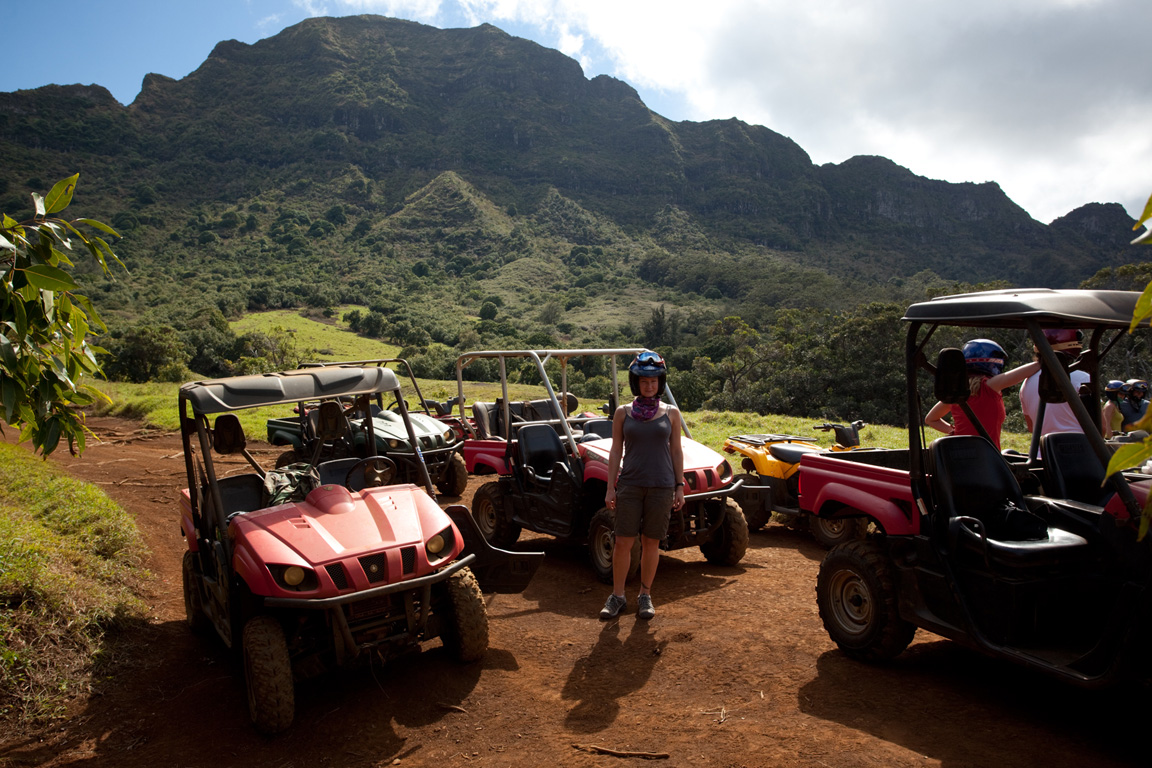
Maree stands under Mt. Haupu near an area featured in Jurrassic Park.

Our ATV tour was more entertaining than I had imagined it would be. We decided on an outfit called Kipu Ranch Adventures. Our guides were great guys, very friendly and knowledgeable, and funny without being cheesy. They worked hard, kinda, and seemed to enjoy their job. The tour is all within the boundaries of a huge 3,000 acre ranch, and visits numerous Hollywood movie sites. It also offered a view into a hidden, privately owned valley that is not visible from any public roads. It was given by the King of the island to a family of ranchers for a period of seven generations. That time period has nearly expired, and the fate of the valley in uncertain at this point.

From a pass near the top of Mt. Haupu we were able to see the private, hidden valley of Kipu Kai, where they filmed much of Six Days and Seven Nights. 

 On the way back down the mountain, this part was on a thinly paved road.

You can choose to ride a typical ATV or ride one of those two person vehicles. I chose the latter, because i'd never driven an ATV with a steering wheel and wanted to try that out. I had also hoped that maybe Maree could drive some times so i could take pictures, but they only let one person drive, and it was WAY to dusty to pull my camera out while riding. Sometimes visibility was close to zero during the faster moving sections. They warn you to wear clothes that you can throw away and they weren't kidding. The volcanic red dust didn't wash out. I was glad i brought my camera in a waterproof bag.

 This is part of the hill in Indiana Jones and the Lost Ark, where Indy gets chased by natives in the first scene in the movie.


                   Above: After our tour we were pretty filthy.
Left: The tree where Indiana swung from a vine into the water is still there, and now it's a rope swing! More on swimming holes below. 


Our guides told us this is how they season their pigs, with flavored soda. Like chickens, feral pigs are all over the island. With fish, pigs, and chickens running rampant, it would not be easy to survive here.


Hiking and Swimming

The ocean was pretty rough while we were there, as it typically is in winter, so we stuck with land activities for much of the time. Maui offers virtually no hiking at all, except in the National Park, and there are few trails even there, except at 13,000 ft. Kauai has lots of trails, and has some of the best scenery in the world to hike through. I had 4 or 5 hikes in mind, but only managed three. Two hikes were along the Na Pali Coast, but i'll get to those in the next blog post.

Part of the trail along the irrigation ditch. Nearby the ditch goes into a low 800 foot tunnel that you can walk through, bent over, if you desire.

 In the distance is the mountain where the wettest spot on earth is supposed to be. It's normally covered in waterfalls. Our helicopter tour took us back there.

We did another short hike to a freshwater jungle swimming hole. Getting to the trail head in our crappy PT Cruiser was more of a challenge than the actual hike, and i ended up getting a flat tire. I didn't notice the tire until 6 hours later, but still, it's pretty pitiful since the road wasn't what i would consider a bad road.

The swimming hole. There's a concrete damn up there, and the irrigation ditch comes out of the tunnel on the left, then continues to a lock system off to the right. The water was incredibly cold, and a strong current would initially pull you quickly towards the little falls, then spit you out to the side.

The road that the Cruiser couldn't handle. On the way back we picked up a Canadian hiker and gave him a lift back to his car, about 4 miles down the road. He had just finished working on the Olympic preparations in Vancouver, and had decided to get out of town once the  Winter Olympics officially began. He was  a nice guy.

Another option for swimming. On the north end of the island are some large, ominous sea caves. Now after many years of changing tides and currents the caves are inland. Some are dry but this one was filled with deep fresh water. A sign claimed you would die from a cave in if you tried swimming.


Helicopter Touring


The helicopter, tour was a much better value for our money than the one we had on Maui. The helicopter will take you around the entire island, over and through remote canyons, past endless waterfalls, and along the entire Na Pali Coast. It was the most scenic flight tour i've ever been on (other than the Ruth Gorge in the Alaska Range), even though it was raining for much of the tour. This time our helicopter was smaller than the one we had on Maui, and it had doors on it. The windows go all the way down the side, offering great visibility, but as i feared, the reflections on the glass were out of control, even with a polarizer. And I had to bribe someone to get a front seat.

This is an area of immense scale, one of the most sacred sites to Hawaiians, where water gushes out from a huge overhang beneath immense cliffs on the wettest part of the island. It was dark back here.

Turning around from the waterfalls you can see the deep narrow valley we were flying through. This was my favorite part of the air tour. 

We flew up a long steamy looking jungle valley. The rain may have made this portion of the flight more interesting.

 I think this was over the Kipu Ranch area.

The National Botanical Gardens


We weren't originally going to go to the Botanical Gardens on the south side of the island (not the gardens to the North), but on our last day we had to burn up 7 hours after we checked out of our hotel before we could get on our plane. I didn't want to get dirty doing something like hiking or swimming, so we went to the gardens.  I can't say i recommend the place. It's divided into two areas. A "good" area that costs $40 to get into, and a mediocre area, which still costs $20. Additionally you can't just drive up and walk in. There is no parking in the garden, and the 15 minute shuttle ride only goes in and out once every hour. I've been to several other botanical gardens that are of better quality and much cheaper to get into, and compared to the plants you can see everywhere else on the island, it's just not worth the money.


 This was one of the prettier areas.

There's an area of the gardens that you also have to pay extra for for and be driven too, where there is a grove of very large versions of this kind of tree.

Next Time: The Na Pali Coast