26 Eylül 2011 Pazartesi

San Diego, California

People who have lived in San Diego complain about the weather. They say it's just too perfect. People will complain about anything.  Many of the Hawaiians that live in Alaska have told me the same thing about Hawaii. "You just get tired of paradise" they say.

I just got back from a short trip where the weather was sunny and cloudless almost every single day. A few of the days were identical. But when i got back to Alaska i was thrown back into cloudy fall days, and i have to say it was refreshing. There may be some truth to the idea that a monotony of perfect weather can get old.

The beach at Point Lomo. I wanted to get down on the beach and to do that i needed to find the stairs at the far end, but i ran out of time, unfamiliar with the streets. It worked out well anyway.


Everyone always tells me San Diego is super nice. Some people have even told me that it is too nice to live in, insofar as life is too easy there. I don't know about that. After a brief two days in the city it seemed pretty darned livable to me.... The best Mexican food in the country, great weather, clean parks, a beautiful coastline, the only thing that bothered me was the frequent drone of Apache Helicopters patrolling the border and coastline.

Historically San Diego was the home of the Kumeyaay Natives for 10,000 years before being claimed by the Spanish in the late 1700's. Then it became part of Mexico for 30 years before anchoring the US border in 1850. It is the oldest city in California.

Downtown San Diego. Embarcadero Marina Park is a pleasant walk along the waterfront.  The people in the distance made us get out of the way because they were apparently doing an Oakley Sunglasses photo shoot. They said i wasn't pretty enough to be in the picture.

Meerkats. Wildlife photography is soooo much easier when the wildlife is imprisoned.

They have no self respect.

The zoo was not quite as great as i'd heard, but was certainly above average. It was possibly the most crowded zoo i've ever been too. What i've noticed about zoos is that the herbivores seem to do alright, while the predators seem to suffer greatly from the confinement. The San Deigo zoo was a pioneer in creating cages without "the cage". There are few, if any, bars and most animals can be observed without fencing in the way.

The Elephants had a lot of space for a zoo.


A glimpse of the city from the gondola. The zoo is part of Balboa Park, a huge collection of museums and parkland originally built for the World Exposition of 1915.


This bird wanted me dead.

There were a couple of walk in aviaries that were nice because the birds were flying all around you in a large greenhouse setting.

The primates looked typically unhappy under constant observation.


 Our hotel, (Best Western Hacienda in Old Town) looked really cool on the outside, but had no elevators, and was stretched across a huge 7 story plot of land. Unfortunately the rooms were sub par and the staff was careless and unthoughtful.

This is inside what i think they said was the oldest building in San Diego. A ranch home in Old Town. I wish our hotel room had been this nice.

This is San Diego today. People come to this famous tram station for it's magical healing powers.

Downtown has a nice outdoor mall called Horton Plaza. I don't usually go to malls but Maree had to go to the Hello Kitty store, so i had nothing to do for an hour. The center picture is from Old Town.


A nifty restaurant at the marina park downtown.

The city also has photogenic smog that makes for nice sunsets.

25 Eylül 2011 Pazar

Recommendation nº 6: The three little wolves and the big bad pig

Front cover


I've decided to feature two recommendations this month, to keep with the theme of traditional stories.   This is a wonderful title, and recommended by Helen Davies, an English teacher in a French state school.  A great suggestion Helen, and I've had loads of fun looking at this picturebook, discovering all sorts.  

Eugene Trivizas is a sociologist, with a PhD in criminology and one of Greece's leading children's authors. He's written over 100 children's books and this title was the first to be written in English.  I've already featured a picturebook illustrated by Helen Oxenbury, and her delightfully detailed watercolour illustrations bring another dimension to Trivizas already very funny words.  
The three little wolves and the big bad pig is of course a retelling of the traditional story, The three little pigs and highly suitable for older students.  Helen has used this picturebook with teens. 
The front cover is an illustration of The Three Little Wolves taking a break from building work, perched on scaffolding.  Each is nibbling something meaty, a chicken drum stick or a hamburger.  They look relaxed and happy, fastidious with checkered napkins on their laps and open lunch boxes at their sides.   It's a great cover image setting the scene for the many building projects which we will be shown as the story progresses.   However,  only the three wolves appear on the front cover and they are without doubt the goodies, but try turning over to the back cover...
Back cover
The back cover continues the illustration with scaffolding stretching across the picture, and here we see the Big Bad Pig, climbing up a ladder and leering in the direction of The Little Wolves.  It's a wonderful combination and well worth opening out the book to show the continuous image. 
The title page shows us one of the creatures we will encounter later, a beaver, well-known in the animal world for his strong dams.  He's shown next to a dirty bucket, but it's not clear till later what is actually in the bucket.
Recto 1
The first page is a single recto. A large amount of text explains which of the wolves is the oldest, "The first was black, the second was grey and the third was white."  Mother wolf tells her cubs they have to go out into the big world.  She warns them to take care of ... can you guess... the big bad pig! But look carefully at the illustrations. What is mother wolf doing? Painting her nails black!  The fur on her head is in curlers and the end of her tail, which is sticking out of the bed covers, is also in curlers.  She has a flippant look to her, tired of her cubs and ready for the good life again, the posh red slippers on the floor by the bed giving us an inkling of the way she likes to dress. 
Off go the wolf cubs and they soon meet a kangaroo carrying red and yellow bricks.  
Opening 2
As with the original story, the wolves are given what they ask for and they work hard to build their strong house of bricks.  Their lawn grows quickly too, and one day while they are playing croquet the "big bad pig came prowling down the road".  We are then treated to the well-known question answer routine, accompanied by Helen Oxenbury's delightful tongue-in-cheek paintings, showing a mean old pig and scared wolf cubs.
"Little wolves, little wolves, let me come in!"
"'No, no, no,' said the three little wolves.  "By the hair on our chinny-chin-chins, we will not let you in, not for all the tea leaves in our china teapot!'"  
Then, the pig "puffed and he puffed and he huffed and he huffed, but the house didn't fall down." 
Opening 5
"But the pig wasn't called big and bad for nothing." What did he do? He got his sledgehammer and knocked the house down!  Look carefully at the illustration, can you see the wolf cubs escaping?  The black wolf is carrying a china teapot!  They are very frightened.
We know how the story goes: the wolves need to build  a stronger house, but what is stronger than bricks?  Concrete!  They meet a beaver who is making concrete in a mixer.  He gives them all they need and they work hard on their new concrete home.
Opening 7
They are playing badminton when the big bad pig arrives. Opening 7 is a great double spread, a small black and white sketch of the pig, looking thoroughly mean and the wolves in grey tone against their grey concrete house.  The pig is a bright pink peering over the wall in the background, can you see him? 
We are told of the question answer routine, "Little, frightened wolves, let me in...."  and then when we turn the page... "But the pig wasn't called big and bad for nothing."
Opening 8
He gets "his pneumatic drill and smashes the house down"!   The close up of the pink pig with the wolves escaping in the background is hilarious.  They have tied their sheets to make a rope and the teapot is there, ready to be grasped as they flee, "but their chinny-chin-chins were trembling and trembling and trembling."
An even stronger house is needed. Luckily for the wolves, they meet a rhino driving a lorry full of "barbed wire, iron bars, armour plates and heavy metal padlocks."  "The three little wolves built  themselves an extremely strong house" and felt "very relaxed and absolutely safe"! 
This time the wolves were playing hopscotch when the pig arrives. 
Opening 11
That pig is diffiuclt to stop.  Alert students will notice the red dynamite sticks on the grass under the pig in verso and, during the usual dialogue and huffing and puffing, they already know how the big bad pig is going to destroy the house.  "Frightened little pigs, with the trembling chins, let me in!"
Opening 12
And the little wolves are running off carrying their teapot, their fluffy tails scorched.
What could they do now?  They were certain there was something wrong with their building materials. Luckily for them along came a flamingo pushing a wheelbarrow full of flowers.  
Opening 13
And they decided to build a house of flowers. It had a wall of marigolds, one of daffoldils, one of pink roses and another of cherry blossom.  The roof was made of sun flowers and they had a carpet of daisies.  It was beautiful, but very fragile. And along came the big bad pig. "Little frightened wolves with the trembling chins and the scorched tails, let me in!"
And as the pig inhaled to blow down their house ...
Opening 15
The scent from the blossoms softened his heart and he realized how terrible he had been ... "he became a big good pig". He sang and he danced and made freinds with the wolves.  They played "pig-pong and piggy-in-the-middle", and they invited him in for tea and they all lived happily ever after!
Back verso
Can you see? They are drinking tea from the teapot they salvaged from each house, as they ran for their lives. 


Hilariously funny, and kids just love the absurdity of the pig's badness and the ever stronger houses culminating in a soft swaying flowery one. Brilliant adaptation, with stunning illustrations.  It begs rereading, enabling students to discover threads of visual and verbal narratives: Visually they will pick up on the different playground games, the animals and their goods, the teapot at each escape.  Verbally they will enjoy the cumulative greeting from the pig, who begins by calling the wolves, "Little wolves, let me in!", and finishes with, "Little, frightened wolves with the trembling chins and the scorched tails, let me in!" They'll join in the memorable dialogues, and will love saying, "But the pig wasn't called big and bad for nothing."


Helen describes using the book as a base for re-telling well-known stories, with students creating their own retold stories.  Other writing activities could include:

  • Taking the view of the pig and describing being bad and then becoming good, and explaining why;  
  • Becoming a reporter and writing up the story for a newspaper. 
  • Writing a post card to mother wolf from the cubs, explaining the events, and the happy eneding. 

These are challenging activities, but possible with older students who have a fair bit of language competece.   This link, to a set of Scholastic activities, meant for mainstream learners but useful for ideas, may be of interest.  Enjoy!

18 Eylül 2011 Pazar

Recommendation nº 5: The gigantic turnip

Front cover
The Gigantic Turnip, illustrated by Niamh Sharkey has been recommended by Teresa Fleta, a teacher, teacher educator and great friend, who lives in Madrid, Spain.  I'd only seen this title in Portuguese, so it was good to order it in English and give it a good look over. 
I've already featured a picturebook by Niamh Sharkey, an Irish illustrator who uses oil paints to create her big, bold illustrations.   You can see her brush strokes in some of the backgrounds and they add a lovely textured feel to her work.  
This particular picturebook is published by Barefoot Booksthey have a very special publishing moto, here's a part of it: "Interactive, playful and beautiful, our products combine the best of the present with the best of the past to educate our children as the caretakers of tomorrow".  
As you can see from the front cover the book comes with a CD which contains the narrated story - a nice addition, read by clear-voiced Ellen Verenieks.  
We all know the Russian folk tale, made famous by Aleksei Tolstoy, about an old couple who plant some turnip seeds and one grows to such an enormous size that they can't pull it out without help from their animals.  It's a cumulative story, getting longer and longer as more animals are called to help the old couple.  Finally they manage to pull up the turnip with the help of a mouse and everyone eats a very large amount of turnip soup or stew.  It's well known in ELT, and included in course books and reader sets
Portuguese turnips
The big orange root vegetable we can see on the front cover is actually quite unlike a turnip.  Turnips are white with a purpley top.  The turnip in the illustration looks more like a swede, of similar shape, but more orangey in colour and completely different in taste. But this is a cultural thing, for in Ireland and Scotland, swedes are called turnips! In the States they're called swedish turnips.  When I show this image to my students they can't quite match their Portuguese turnips with this yellow thing! 
But let's look at the book, the back cover has a nice collection of other vegetables for us to look at, most of which are immediately recognisable. 
Back cover
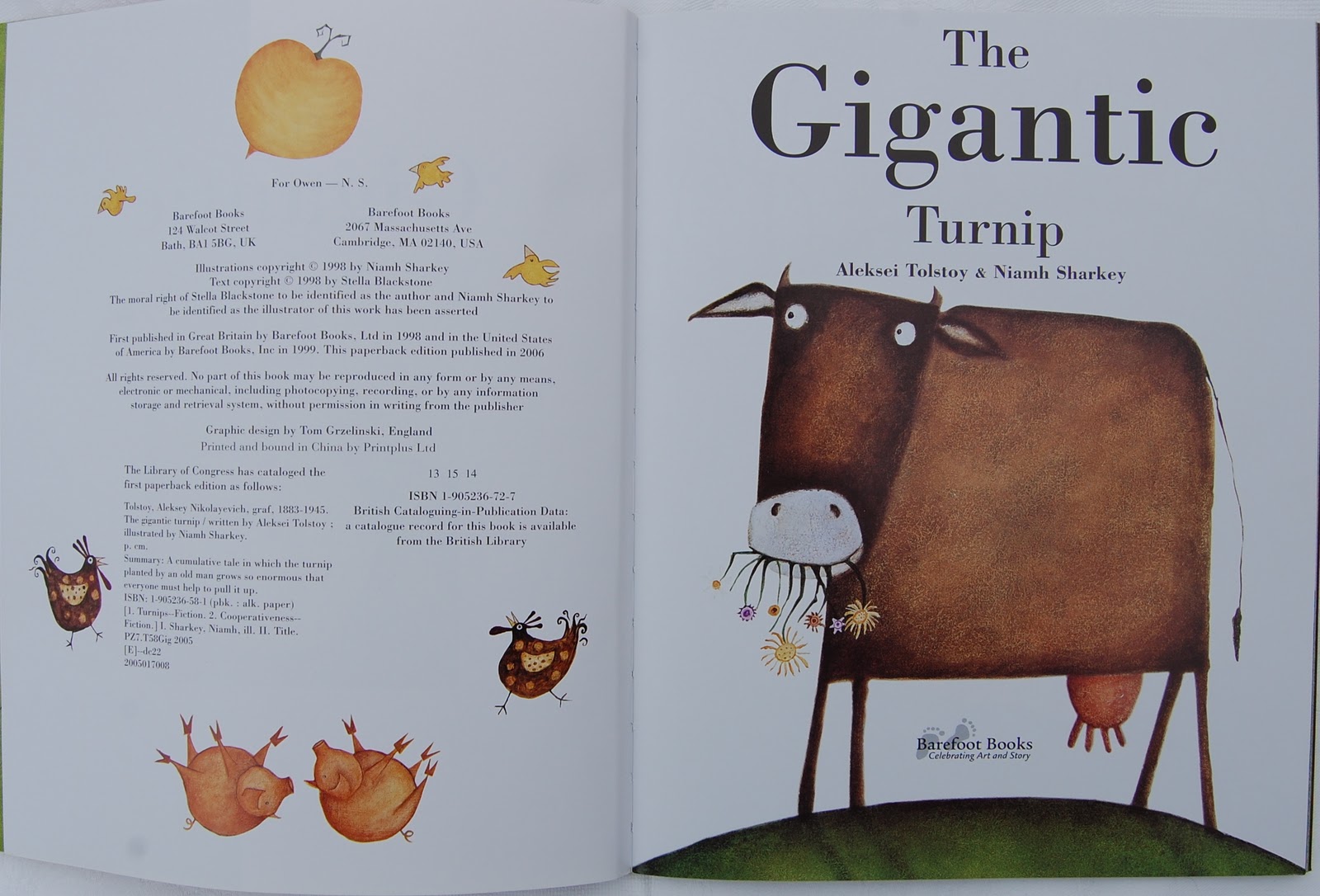
The half title page contains a small cameo of the elderly couple pulling at the turnip, an illustration which is also shown later in the story, and the copyright and title pages introduce us to some of the characters in the story, again snippets from within. They don't contribute in any way to the narrative, though children will comment on the large cow underneath the title  during repeated reads, confirming it is the cow from the story. 
Copyright and title page
The first spread introduces us to the couple, in their overgrown garden, with the verbal text appearing in the garden path, with the font changing size.  
Opening 1
The following spreads set the scene, introducing the animals in the story, and the act of planting. Here are the animals.  Note they start in the verso with the smallest of animals and finish in recto with the big brown cow. 
Opening 2
We need rain for plants to grow, so along it comes beautifully depicted in this spread showing the dark night and the plants in the garden beginning to grow.  Can you see the turnip leaves already big and strong?
Opening 4
We are told, not shown that the seasons pass, everything is harvested and that at the end of the row there is a gigantic turnip.
Opening 5
Nice use of space here, and children really get a feel for the size of the turnip.   The enlarged font works well too. And so the next day the old man got up ... there's a lovely bit where the verbal text says, "the old man sat up in bed, sniffed the cool, late summer air and said, 'It's time for us to pull up that turnip.'",   And he really did try, and here begins the cumulative, repetitive part of the story : "The old man pulled and heaved and tugged and yanked, but the turnip would not move."   And so he calls his wife, and they "... pulled and heaved and tugged and yanked, but the turnip would not move."  The woman fetched the brown cow. 
Opening 9
Can you see the pigs in the background?  On each occasion we are shown the animals who will be called to help when everyone is unable to budge the turnip.  And of course they get smaller in size and larger in number.  "The old man, the old woman, the big brown cow, two pot-bellied pigs, three black cats, four speckled hens, five white geese, and six yellow canaries, pulled and heaved and tugged and yanked. STILL the turnip would not move." 
Opening 14
They were  all exhausted! "But the woman had an idea." She found a mouse, who she caught using some cheese, and she took him outside to help. 
Opening 17
And so now it was almost night time, they've spent all day trying to pull up this turnip!  "The old man, the old woman, the big brown cow, two pot-bellied pigs, three black cats, four speckled hens, five white geese, and six yellow canaries, and the hungry little mouse pulled and heaved and tugged and yanked."  
Opening 18
"POP!", every thing went backwards ... "The canaries fell on the mouse, the geese fell on the canaries... [and so on].  All of them lay on the ground and laughed." The turnip could almost be a planet in this illustration it is so big!   Every one ate the huge turnip stew, but "the hungry little mouse ate most of all."

The mouse also has a lunar look to him in the illustration, with the night sky as a background.  

Facing the verso illustration, you can see the CD and back flap with information about the illustrator, narrator and Barefoot Books.  All nicely compact. 

It's a nice version of the traditional story, with lovely illustrations.  The verbal text is long, but much of it is repetitive, and the children will enjoy chorusing the different animals, especially "two pot-bellied pigs". Teresa didn't give me any follow up activities, but we can all imagine a fun dramatisation with masks and enough characters for a classroom of 25, if one child is the turnip! Great fun!  But most of all read this several times over a number of lessons.  The exposure to the rich language will help children remember it and they'll soon join in. 

Thanks to Teresa for sharing!

13 Eylül 2011 Salı

Los Angeles, California


Until this spring, i had only been to Los Angeles twice in the past. Once for a couple of days with a friend who lived in Huntington Beach back when i worked in Sequoia National Park, some 15 years ago, and then a few years ago during a 10 hour layover on the way to New Zealand. The first time i did typical dumb tourist stuff like walking around in Hollywood and it left a bad taste in my mouth. If the choice is between living in a giant forest at 7,000 feet, or hanging out in seedy Hollywood, the answer is clear. I was so jet lagged the second time that the only thing i remember is a nice meal and a something like a dinosaur hedge fountain.


This past spring, i went down there for the third time to visit my friend Jimmy, and to finally fulfill my promise to Maree to take her to some roller coasters. She is a roller coaster fanatic and has been begging me for years to go to places i have no interest in just because there are roller coasters.


Jimmy and his wife Michi took us to a bunch of good restaurants, to their friend's beach house on Newport Beach, and to ride roller coasters at both Knots Berry Farms and Disneyland. This worked out really well. I got to visit my friend, and Maree got to go on roller coasters. It worked out doubly well since i haven't been to either of those parks.

Grand Central Market has been around since 1917.


Jimmy took us on a short Blade Runner tour. This is the Bradbury building, very nicely renovated. In the movie this is the dank building where wear J.F. Sebastian lives.


The Walt Disney Concert Hall in downtown is home for the L.A. Philharmonic . A pretty neat building, as are all of Frank Gehry's designs, it looks as strange on the inside as it does on the outside.


Knots Berry Farms was somewhat disappointing in its look and feel. Although they had more manly rides than Disney, the park layout and decor is unattractive. And it's a lot smaller than i thought it was, while being pretty much just as expensive as Disney. Disneyland was smaller than i expected, but the outlying areas associated with the park were larger. I think what i liked best was the Matterhorn, one of the rides not available in Disneyworld.

We had a great time. It was nice to get away from Alaska during pre-breakup. I'd have more pictures but i decided one day to stick with just my phone, and as soon as i tried to use it i found out the battery had died because it spent the whole night looking for a signal in Jimmies subterranean apartment.

Ready for phone pictures? Michi, Jimi, Jeff, and Maree on Newport Beach.


Newport Beach. Jimmy's friend Neha spends a lot of weekends here and allowed us to stay the night on our way to Disney. Thanks Neha!

The scenery during the wait for the Indiana Jones ride, Maree in front of the Magic Kingdom? And some 1960's looking architecture.

Disney generally feels pretty safe, but if you don't pay attention to where you're going you could end up in dire straits.

Toon Town ... Jimmy wore attire to blend in perfectly ... some surprisingly spooky treehouse.

Jimmy and Michi on the Matterhorn. Maree and Jimmy at Indiana Jones.


Maree was super excited. Jimmy was very sophisticated all day long. Michi was super bored because she hates Disneyland.